
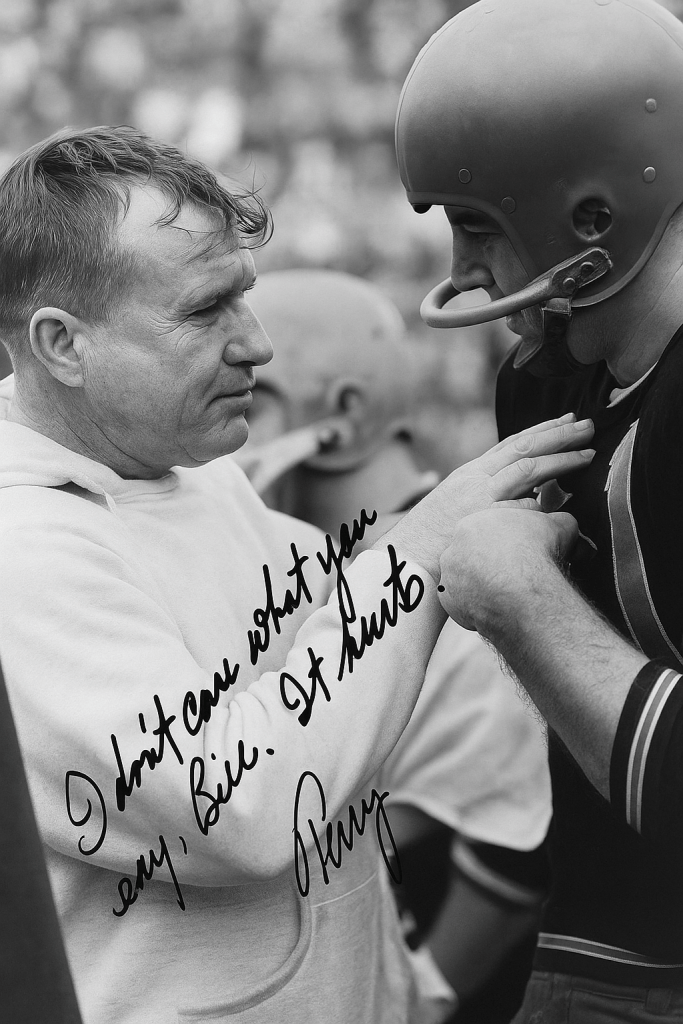
Remembering the athletic trainer behind generations of OSU greats
For 35 years, William “Ropes” Barr Robertson, ’41, was a constant presence in Oregon State University Athletics — tending injuries, steadying nerves and shaping the lives of student-athletes across sports and generations.
Robertson served as OSU’s first — and for some years only — athletic trainer from 1945 to 1980. In 1972, he also helped launch the university’s academic athletic training program in what’s now the College of Health.
His nickname dated to his World War II service with the U.S. Army’s 10th Mountain Division, where fellow soldier Gene Winters dubbed him “Rope-Sole” for his rope-wrapped climbing shoes. According to Robertson’s wife, Mary, one day Winters strolled into his office and said, “How are ya doing, Ropes?” The athletes in the room loved it, and the nickname stuck.
On campus, Robertson was known as the “poet laureate of the locker room.” A gifted storyteller, he rewrote verses on the fly to suit the lesson a player needed to hear. His signature performance was a dramatic recitation of Casey at the Bat, personalized anew for the moment and the listener.
Former Beavers MVP quarterback Steve Preece, ’68, says Robertson was a kid at heart with an instinct for reading people and situations.
“He’d start talking about a friend of his and pretty soon you’d realize you’re in the middle of something he’d recited over and over,” Preece recalls. “I must have heard Mighty Casey 50 times, and each time you felt like you were Casey. He would be animated and almost in tears. He was a magician.”
That charm extended well beyond the training room. When the Beavers basketball team played Louisiana State University in December 1969, during Preece’s rookie year with the New Orleans Saints, Robertson came to a party at the house Preece shared with teammates. Preece remembers Robertson stepping up to an open microphone during the band’s intermission and telling stories for 30 minutes until he had to give up the stage — to protests and boos from the crowd.
But for the athletes he worked with, Robertson’s importance was less about performance than presence. “He kept me upright for four years,” Preece says. “And he did it for about 30 other guys, which is why they loved him. To Ropes, everything was fixable. He made you feel good; he got you.”
Terry Baker, ’63 — the only student-athlete ever to both win the Heisman Trophy and play in the Final Four — remembers Ropes well. “Ropes let me hang out at his house, he loaned me his car, and he liked to have a good time,” Baker says. “He was like a buddy.”
Baker laughs as he recalls sneaking out of a hotel room with basketball teammate Steve Pauly one night in Idaho. When they returned, they found a locked-out Coach A.T. “Slats” Gill attempting to hoist Robertson through the transom window of his room. Gill’s son was deaf and couldn’t hear them knocking.
After Robertson’s death in November 1980, 400 people gathered at Gill Coliseum to honor “one of Oregon State’s great human beings.” Preece served as master of ceremonies, joined by other alumni sports greats including brothers Jimmy Clark, ’53, and Herman Clark, ’55. The governor declared the day “Bill Robertson Day.”
Then-OSU athletic director Dee Andros captured the sentiment well: “We have lost one of the great Beavers of all time. He was right at the top of my list of nice guys. He loved the kids, and that is what made him so good at his job.”
Today, Robertson’s legacy continues through the William “Ropes” Robertson Endowed Athletic Training Student Success Fund, which supports students in the program he helped establish. Donate at https://beav.es/Sbc.
This story appeared in the winter 2026 issue of the Oregon Stater alumni magazine.
Writer’s note:
For the last eight months, I’ve dug into learning about Ropes and the golden age of OSU football, which felt like an unlikely topic of research at best. A lukewarm sports fan and a native Midwesterner who grew up a few decades after the “Giant Killers,” I wasn’t exactly familiar with the history of the era’s greats.
Nevertheless, soon I was calling Steve Preece and Terry Baker, OSU gridiron legends who were kind, humble, funny and happy to share stories that are slowly fading with time. Even so, as Maya Angelou said, people will forget what you said and did but not how you made them feel, and it was clear that Ropes made them feel seen, heard, respected and cared for — as athletes and as people.
Through their eyes, I could see them couch surfing at Ropes’s house, along with friend and high jumper Dick Fosbury, ’72; imagine Ropes animatedly delivering one of his famous poems; and at the same time remember the true value of sport – not licensing deals or TV revenue, but a deep-felt love of the game and putting your team’s success above your own.
A mountain climber who scaled Mt. Hood 25 times, a Purple Heart recipient, a devoted father, husband, friend and coach, it’s only fitting this master storyteller’s life was itself one rousing, fantastic tale.
Thanks for reading,
Kathryn
 katalyst communications
Leave a comment